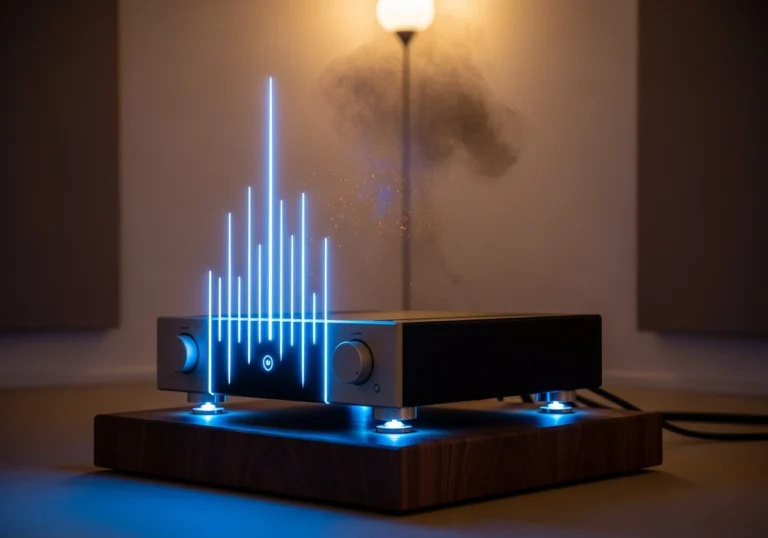
I have a close friend who is a hardcore tech skeptic. Whenever the topic of high-end audiophile cables and audio setup comes up, his response is always the same: “Copper is copper. Electrons move at the speed of light. Why would an expensive cable sound better than a $10 Monoprice cord? It’s all placebo and marketing snake oil.”
And honestly? In most real-world scenarios, he is absolutely right. But not for the reasons he thinks.
The master rule of high-end audio is simple: A premium component or cable doesn’t improve the sound; it simply ruins it less. Every element in your signal chain acts as a filter or a bottleneck. However, the biggest mistake most audiophiles make is investing thousands of dollars into premium audiophile cables while placing their heavy gear on standard, resonant furniture.
If your system lacks proper mechanical isolation, your expensive cables are physically blocked from doing their job. Here is the pure, unadulterated physics of why audio cables and component racks must work together—and why vibration isolation is the true foundation of high-fidelity sound.
Argument 1: The Micro-Structure of Copper vs. Microphonic Vibrations
The Cable Physics: Standard Oxygen-Free Copper (OFC) wire contains roughly 10,000 to 12,000 grain boundaries per meter, causing tiny phase shifts and micro-resistance. High-end cables solve this by using Ultra Pure Ohno Continuous Casting (UP-OCC) single-crystal copper, allowing the signal to flow effortlessly without structural interruptions.
The Reality Check: You can buy the most perfect single-crystal cable in the world, but if your heavy amplifier or DAC is sitting on a resonant, vibrating wooden cabinet or a piece of glass, you are introducing the microphonic effect.
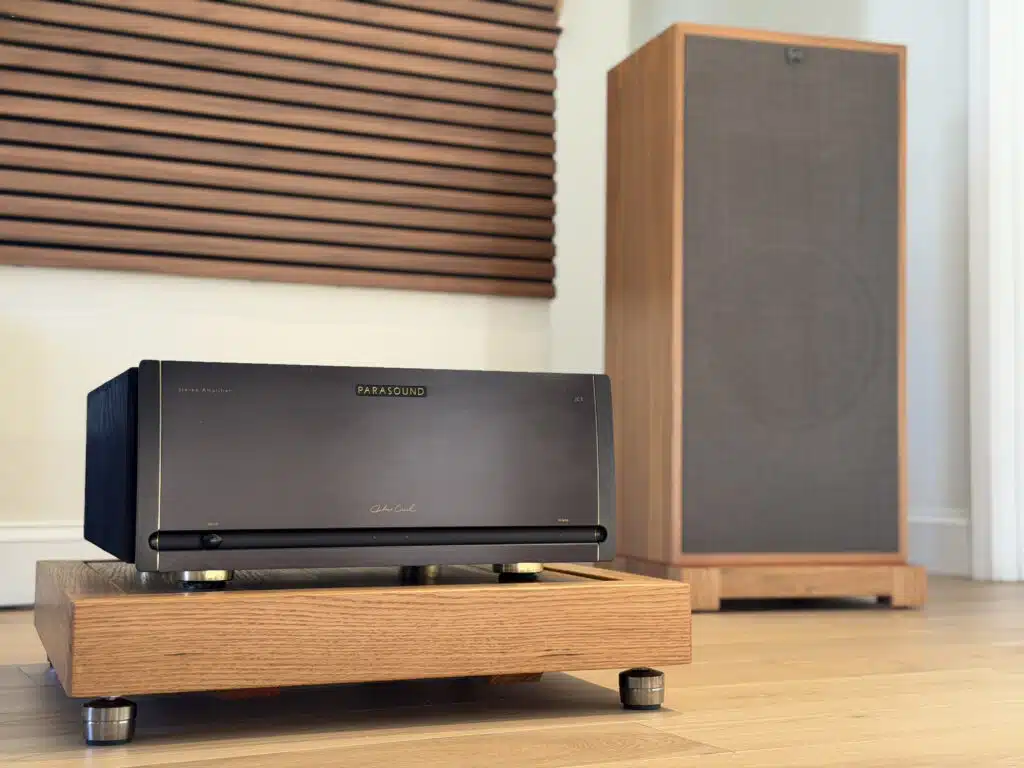
When sound waves from your speakers hit your gear, or when the heavy internal power transformers hum, they create physical micro-vibrations. These mechanical waves travel directly into the internal circuit boards and the connected cables. Under mechanical stress, the physical geometry of the wire changes at a microscopic level, creating tiny changes in capacitance and introducing phase noise.
The Analogy: Buying a premium UP-OCC single-crystal cable while keeping your equipment on a vibrating, un-isolated rack is like putting a flawless, race-tuned sports suspension on a car with a bent, shaky chassis. The suspension can’t do its job if the foundation is constantly warping and rattling.
Argument 2: The Invisible Noise Floor (Shielding vs. Component Resonances)
The Cable Physics: We live in an ocean of Radio Frequency Interference (RFI) and Electromagnetic Interference (EMI) from Wi-Fi routers and smartphones. Premium audiophile cables use heavy, multi-layered shielding and advanced materials like graphene to trap this noise and keep it from introducing intermodulation distortion (IMD) into your digital streamer or pre-amp.
The Reality Check: Advanced shielding lowers the electrical noise floor, giving you that coveted, deep “black background.” But electrical noise is only half the battle. Mechanical vibration is the other half. When a sensitive component like a digital streamer or a tube pre-amplifier is subjected to micro-vibrations, it creates mechanical jitter and circuit noise that acts exactly like RFI/EMI. It blurs the soundstage, smears micro-details, and compresses the depth of the music.

No amount of cable shielding can protect your music from a noise floor raised by a vibrating equipment rack.
The Analogy: Imagine looking at a beautiful master painting through a frame. Premium cable shielding wipes the external dust off the glass. But if the floor beneath you is constantly shaking, your eyes can’t focus on the fine details anyway. You must stop the shaking first.
Argument 3: Dynamic Load and the Kinetic Link (Amplifier Control)
The Cable Physics: Speakers are not simple lightbulbs; they are dynamic, volatile electromechanical loads. When a massive amplifier pushes a heavy woofer, the speaker generates a reverse current spike called Back Electromotive Force (Back EMF). The amplifier must instantly absorb this current to keep the bass tight. Thick-gauge cables and ultra-low resistance connectors maximize this damping factor.
The Reality Check: This is where the physics of electricity meets the physics of kinetic energy. The massive energy required to control heavy woofers creates intense physical feedback loop resonances within the amplifier itself.

If the amplifier is not anchored to a heavy, rigid, energy-dissipating structure, those physical reactions degrade the power supply’s efficiency and muddy the lower frequencies. The bass becomes loose, boomy, and slow—not because the cable resistance is too high, but because the amplifier is physically flexing and vibrating under its own power load.
The Analogy: Think of high-resistance speaker cables as spongy, soft brakes on a sports car. Now imagine mounting the high-end ceramic brakes (thick premium cables and connectors) onto a car with loose, vibrating wheel lugs. The braking force is useless if the wheel assembly itself is shaking apart.
Minimizing contact resistance, maximizing the amplifier’s control. Just like mechanical isolation prevents physical distortion – which is why we craft dedicated audiophile furniture for heavy high-end gear – low resistance cables prevent electrical distortion.
Conclusion: The Law of the Weakest Link
Next time you think about upgrading your system, remember the law of the weakest link: Mechanical isolation is the foundation; cables are the polish. Investing in high-end audio cables without providing a resonance-free environment for your gear is an expensive exercise in diminishing returns. To truly hear what a premium single-crystal or heavily shielded cable can do, you must first eliminate the mechanical chaos in your system.
Before you replace your wires, build a rock-solid, resonance-engineered foundation. Discover how dedicated, artisan-crafted audio furniture can eliminate microphonic distortion and unleash your system’s true potential by exploring our specialized engineering approach at TAFI Made.